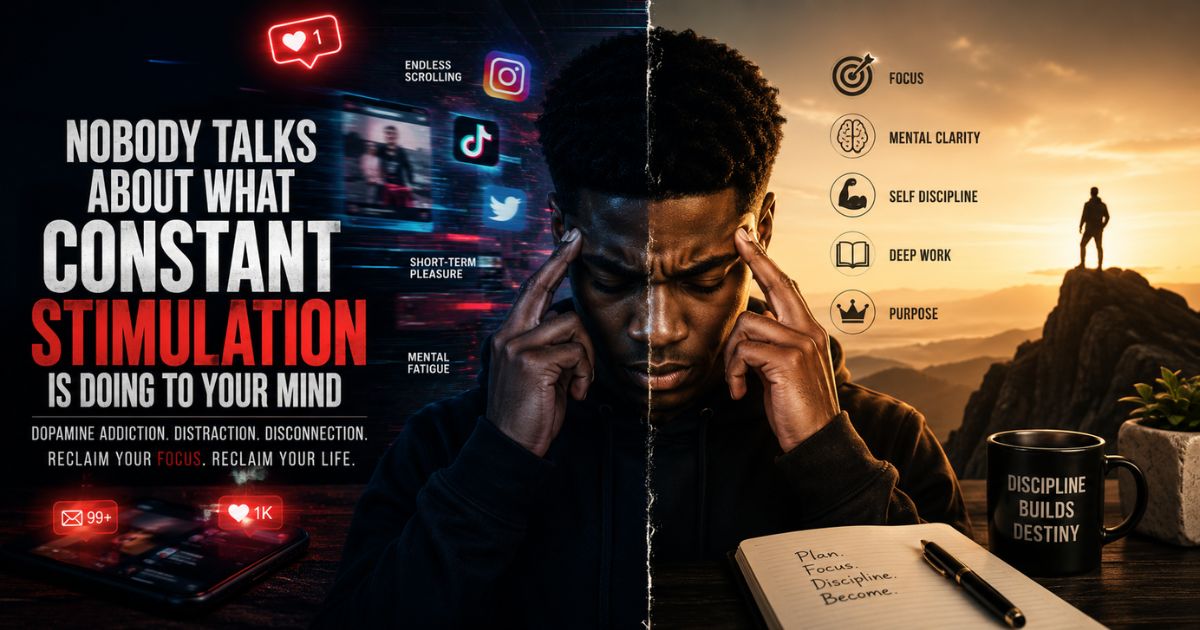
Nobody Talks About What Constant Stimulation Is Doing To Your Mind

How Dopamine Addiction, Social Media, and Modern Noise Are Quietly Destroying Focus, Discipline, and Purpose
The Silent Mental Crisis Nobody Sees
There’s a generation slowly losing its ability to think deeply, focus clearly, and live intentionally — and most people don’t even realize it is happening. Constant stimulation has become so normal that silence now feels uncomfortable. Phones are checked before prayers are said. Notifications interrupt conversations. Endless scrolling replaces reflection. The modern mind is constantly consuming but rarely processing what it absorbs.
We live in a culture that rewards entertainment more than awareness. Every app is designed to hold your attention for as long as possible because attention has become one of the most profitable resources on earth. Social media platforms compete for your focus every second of the day. The result is a distracted generation struggling with discipline, identity, emotional stability, and purpose.
The dangerous part is that overstimulation does not always look destructive in the beginning. Sometimes it looks harmless. A few more videos before bed. Another hour lost on TikTok or Instagram. Constant background noise while working, eating, or driving. Slowly, the brain becomes addicted to stimulation and uncomfortable with stillness, patience, and delayed gratification.
People now fear silence because silence forces confrontation. It exposes unresolved pain, insecurity, confusion, emotional exhaustion, and internal emptiness. Instead of facing reality, many people bury themselves deeper in noise. Social media becomes emotional anesthesia for minds trying to escape themselves.
The Rise of Dopamine Addiction in Modern Culture
Why Your Brain Craves Constant Entertainment
Dopamine addiction is quietly reshaping the way people think, behave, and make decisions. Every notification, short-form video, like, message, and scroll creates small bursts of pleasure inside the brain. Over time, the mind becomes conditioned to seek instant stimulation instead of meaningful progress. Patience begins to feel painful because the brain has been trained to expect constant rewards.
This is why many people struggle to focus on difficult tasks for long periods of time. Reading books feels exhausting. Prayer feels difficult. Deep work feels boring. Building a business feels slow. The nervous system becomes dependent on quick emotional rewards instead of long-term fulfillment. Modern entertainment has conditioned people to chase feelings instead of building character.
The scary truth is that many people no longer know how to sit alone with their own thoughts. They feel anxious when there is no stimulation nearby. Some people cannot eat without watching something. Others cannot sleep without noise playing in the background. The mind becomes so overstimulated that peace begins to feel unfamiliar.
That is the psychological trap of modern culture. It trains people to confuse movement with progress. Watching motivational videos feels productive. Reading quotes feels transformative. Talking about goals feels meaningful. But consumption is not the same thing as execution. Real transformation only begins when action replaces endless stimulation.
How Constant Stimulation Is Destroying Focus and Discipline
The Psychological Cost of Endless Distraction
A distracted mind cannot build a meaningful life. Focus is now one of the rarest skills in modern society because distraction is everywhere. Notifications interrupt concentration. Endless content destroys attention spans. Multitasking weakens deep thinking. Many people start projects but never finish them because their mind has been conditioned to seek novelty instead of mastery.
This is one reason discipline feels impossible for so many people today. Discipline requires repetition, patience, consistency, and sacrifice. But social media trains the brain to crave speed, excitement, and instant results. People want transformation without discomfort. They want confidence without struggle. They want success without sacrifice. Modern culture glorifies outcomes while ignoring the painful process behind greatness.
The human mind was never designed to absorb endless streams of information every waking hour. Too much stimulation creates mental fatigue, emotional restlessness, and psychological fragmentation. Many people feel tired not because life is hard, but because their brain never truly rests. Their nervous system is overloaded every single day.
Information without reflection becomes mental clutter. This is why some people know everything but understand nothing. They consume more content than ever before yet remain emotionally stuck, spiritually disconnected, and mentally exhausted. The modern world has made stimulation cheap and meaning rare.
The Impact of Overstimulation on Masculinity and Identity
Why Modern Men Feel Lost and Mentally Weak
Nobody talks enough about what overstimulation is doing to masculinity. A man constantly distracted by entertainment, validation, and pleasure slowly loses the traits that make him strong. His focus weakens. His patience disappears. His emotional control collapses. He becomes reactive instead of intentional because his mind is constantly overstimulated by modern noise.
Real masculinity is built through restraint, discipline, sacrifice, and purpose. Strong men are not created through endless comfort and entertainment. They are built through hardship, solitude, delayed gratification, and responsibility. But modern culture teaches men to avoid discomfort at all costs. Pleasure is promoted more than purpose. Escape is celebrated more than self-control.
This is why many young men feel mentally exhausted, emotionally confused, and spiritually disconnected. They consume more content than any generation before them, yet feel more directionless. The mind cannot become powerful while constantly distracted. A man who cannot control his attention eventually loses control of his life.
The same applies to women searching for purpose and identity in a world addicted to validation. Constant comparison through social media creates insecurity, anxiety, and emotional instability. Many people now build their self-worth around online attention instead of internal character. They become dependent on external approval because they no longer know who they are without an audience watching.
Why Delayed Gratification Matters More Than Ever
The Power of Patience in a Fast World
Delayed gratification has become rare because modern society is built around instant access. Food is instant. Entertainment is instant. Validation is instant. Everything is designed to remove waiting from human experience. But growth has never worked that way. Real transformation still requires time, consistency, sacrifice, and patience.
The gym is repetitive before it becomes rewarding. Building a meaningful career takes years before recognition appears. Healing emotionally takes time. Spiritual growth requires stillness and discipline. Mastery is slow by nature. People who cannot tolerate discomfort often quit before growth begins. They mistake temporary boredom for failure and abandon the process too early.
Some of the strongest people alive today are simply those who learned to stay committed while others kept chasing distraction. They understand that discipline creates freedom. They know that focus is power. In a world addicted to stimulation, patience has become a competitive advantage.
If you want to rebuild your identity, strengthen your mindset, and develop real discipline in a distracted world, read my ebook “Becoming”. And if you need practical systems to sharpen focus, consistency, and self-control, get the “30 Days Discipline Blueprint.”
Social Media and the War for Your Attention
Why Protecting Your Mind Is a Spiritual Responsibility
Attention is one of the most valuable things you own. Every platform, algorithm, and application is fighting for it because distracted people are easier to influence, manipulate, and monetize. Social media companies study human psychology deeply because the longer you stay emotionally engaged, the more profitable your attention becomes.
This is why reclaiming focus is no longer just a productivity issue. It is a spiritual issue too. You cannot hear God clearly when your mind is crowded with endless noise. You cannot discover purpose while addicted to distraction. Constant stimulation keeps people externally entertained while internally disconnected from themselves.
A focused mind is powerful because it becomes intentional. It chooses what deserves attention instead of reacting emotionally to everything. People who protect their mental environment often think clearer, move calmer, and live with greater purpose. Their peace comes from internal discipline rather than external validation.
The modern world profits from your distraction. But your future depends on your ability to focus. Every great vision, business, relationship, ministry, or transformation requires sustained attention. You cannot build a meaningful life while constantly escaping into entertainment.
Final Thoughts on Constant Stimulation and Mental Discipline
The Future Belongs to Focused People
The people who will lead the future are not the most entertained people. They are the people who learned how to master their attention in a world designed to destroy it. They protect their mind carefully. They choose discipline over distraction. They understand that focus is deeply connected to identity, purpose, faith, and personal transformation.
Modern culture is training people to become mentally weak, emotionally reactive, and spiritually disconnected. But you do not have to live that way. You can reclaim your attention. You can rebuild discipline. You can train your mind to focus deeply again. You can become intentional in a world addicted to noise.
Protect your mind like your future depends on it, because it does. The quality of your attention shapes the quality of your life. And in an age of endless distraction, disciplined focus has become one of the rarest forms of power.
Your transformation will not begin when motivation appears. It will begin the moment you decide that your future matters more than your temporary comfort. That is where identity changes. That is where discipline is born. That is where purpose starts becoming real.
Discover more from Mutembei William
Subscribe to get the latest posts sent to your email.