I Changed My Circle for 30 Days—Here’s What Happened

Most people think their environment doesn’t shape them. They’re wrong.
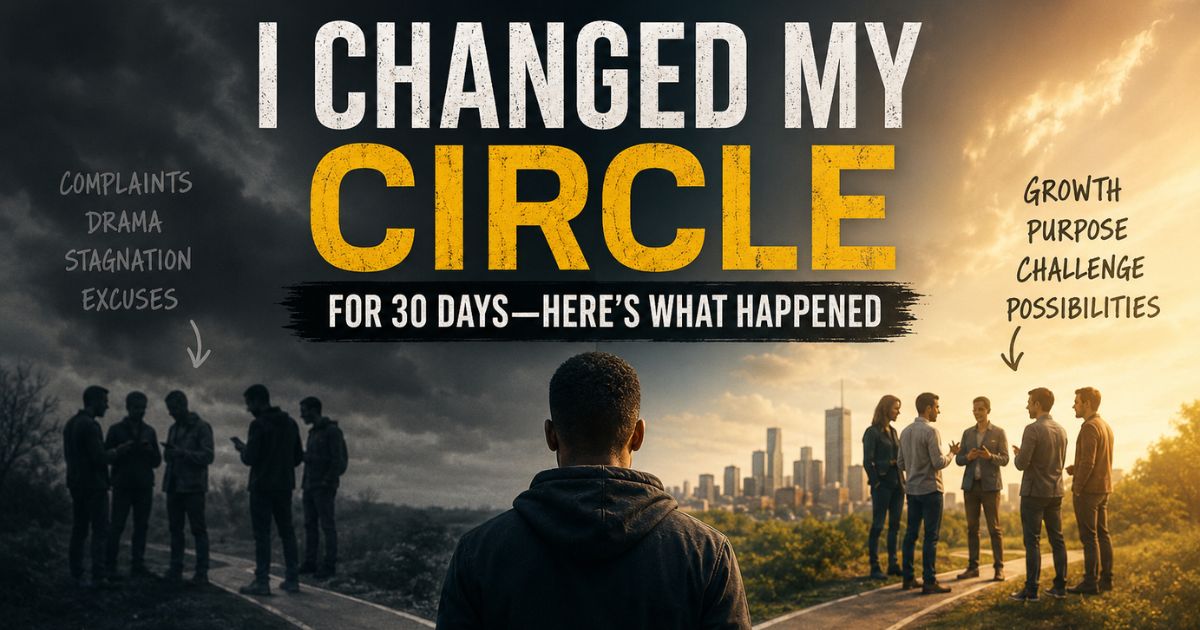
For 30 days, I made one deliberate choice: I started changing my circle. Not dramatically. No burned bridges. No public announcements. I simply pulled back from certain relationships, stepped into rooms I’d been avoiding, and paid close attention to what happened next.
What I found wasn’t just about friendships. It was about identity, energy, and the version of myself I was slowly becoming—without even realizing it.
This is what 30 days of changing your circle actually teaches you.
Why I Started: The Quiet Kind of Stuck
I wasn’t in crisis. I was just… stagnant.
Busy, but not progressing. Smiling in conversations, but going home hollow. I looked at my calendar and asked a dangerous question: Who am I spending the most time with—and where are those people going?
The answers made me uncomfortable.
Some of the people I gave the most hours to were kind, loyal, and genuine. But they were also standing still. Not building. Not asking hard questions. And slowly, without permission, I had matched their pace.
So I ran an experiment. What would happen if, for just 30 days, I rearranged my relational environment?
Lesson 1: Changing Your Circle Changes Your Climate
Your relationships are not just relationships. They are the climate you grow in.
A plant in the wrong soil doesn’t fail because it lacks potential. It fails because the conditions aren’t right.
Within the first week of changing my circle, conversations shifted. Instead of talking about people, we started talking about ideas. Instead of recycling the same complaints, we started asking, What are you building? What problem are you solving right now?
My thinking sharpened almost overnight—not because I was intellectually dependent on others, but because the human brain is deeply social. We calibrate to the people around us. Their pace becomes our pace. Their ceiling quietly becomes our assumption of what’s possible.
“You are the average of the five people you spend the most time with.” — Jim Rohn
I used to skip past that quote. After this experiment, I believe it with conviction.
Lesson 2: Loyalty and Growth Are Not the Same Thing
This one hurt the most.
Changing your circle does not mean abandoning loyalty. But for the first time, I separated two things I had confused for years: loving someone and building your life around them.
Some of the people I stepped back from had been in my life for years. Good people. But our conversations had become a loop—same complaints, same jokes, same smallness. Not out of malice. Just inertia.
Real loyalty isn’t keeping people close regardless of what the closeness is doing to you. Real loyalty is caring enough to grow—so that when you return, you bring more to the table, not just history.
Pulling back was not rejection. It was respect—for my future, and quietly, for theirs too.
Lesson 3: Discomfort in New Rooms Is a Signal, Not a Warning
The new rooms I entered during those 30 days were not always comfortable.
Some conversations made me feel behind. Some people were achieving things I hadn’t yet touched. Some gatherings surfaced insecurities I thought I had resolved.
That discomfort? That was the point.
Comfort is a signal that you’re not stretching. Every time I felt the sting of “these people are ahead of me,” I reframed it: ahead means the path is real. Someone has already walked it and come back with proof.
As Aristotle once said, “Knowing yourself is the beginning of all wisdom.” And you cannot know yourself clearly when everyone around you only reflects back what you already are.
The discomfort of new rooms doesn’t mean you don’t belong. It means you arrived.
Lesson 4: Energy Is Transferred, Not Just Felt
Around Day 10, something subtle but undeniable clicked.
After spending time with certain people, I left with more energy than I arrived with. After others, I left drained—not because anything went wrong, but because the conversation pulled toward complaint, comparison, and stagnation.
This isn’t mystical. It’s neurological. Enthusiasm is contagious. So is resignation.
Here’s the honest test I started applying after changing my circle:
- After this interaction, do I feel more alive or more tired?
- Do I leave with new ideas—or with fresh excuses?
- Do I feel called higher, or quietly confirmed in my smallness?
These questions aren’t about judging people. They’re about being honest with yourself about what each relationship is actually producing in you.
Lesson 5: Your Standards Rise When Your Circle Does
Here’s something that surprised me.
Once I raised my own standards—showing up prepared, following through, asking better questions—the rooms I entered seemed to rise to meet me. Or maybe I had finally started noticing what was always there.
Standards are not perfectionism. They are intention. When you carry yourself as someone serious about growth, people begin to treat you accordingly. And more importantly, you begin attracting people who take themselves seriously too.
This is the compounding effect of changing your circle. Better input leads to better questions. Better questions lead to better decisions. Better decisions, over time, change your life—slowly, then suddenly.
Discipline begins where applause ends. But momentum begins where the right people start to witness you.
The Final Truth: You Are Always Being Formed
Here is what 30 days of changing my circle distilled into one truth:
You are always being formed by something. The only question is whether you’re conscious of what that something is.
Your circle is forming you. Your conversations are forming you. The rooms you enter and the rooms you avoid—all of it is quietly shaping who you are becoming. Most people wait for a dramatic crisis before making relational changes. But the slow drift—staying in circles that have stopped serving your growth—is just as costly. It’s just quieter. And quiet is easier to ignore.
Your 30-Day Challenge
You don’t need to cut anyone off. You just need to be intentional.
For the next 30 days, try this:
- Audit your circle. After every significant interaction, ask: did that conversation pull me higher or hold me back?
- Enter one uncomfortable room. A mastermind, a new network, a mentorship conversation—somewhere you feel slightly behind. Stay.
- Protect your solitude. Create space to hear your own voice, separate from everyone else’s expectations.
Changing your circle isn’t an act of arrogance. It’s an act of stewardship—over the one life you’ve been given to build.
Change the climate. Watch what grows.
Discover more from Mutembei William
Subscribe to get the latest posts sent to your email.