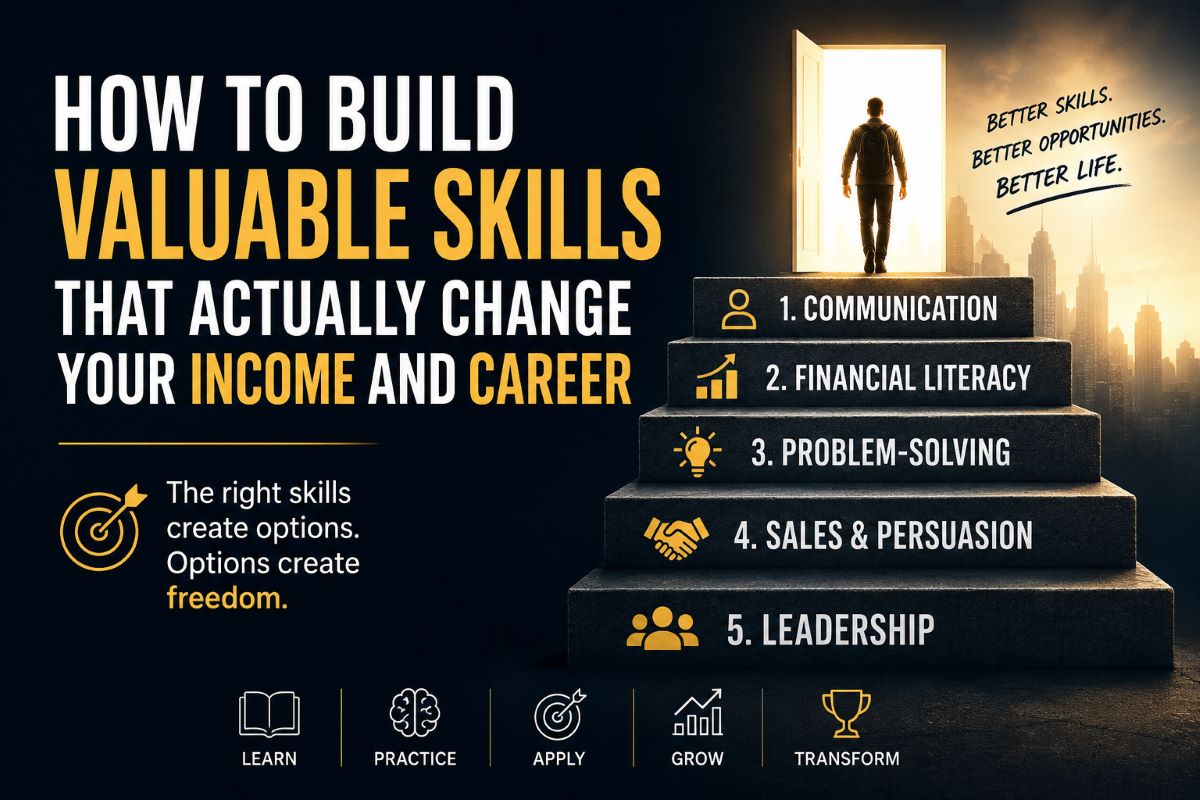
How to Build Valuable Skills

If you want to change your financial situation, learning how to build valuable skills is the most direct path available to you — and one of the few that is entirely within your control.
Most people spend years chasing trends, copying whoever seems to be winning right now, and looking for the fastest path to results. They overlook the one thing that creates lasting change: deliberately building skills the market actually pays for.
This article breaks down exactly which skills are worth building, why they matter, and how to develop them — without wasting time on the ones that will not move the needle.
Why Building Valuable Skills Matters More Than Chasing Money
Here is the pattern you see in people who have genuinely changed their circumstances: they built skills first. Income followed.
That is not an accident. The market does not reward effort evenly. It rewards value. And value, in almost every professional and entrepreneurial context, comes down to one thing: what specific problems can you solve, and how well can you solve them.
Generic skills produce generic income. Specific, high-demand skills produce leverage — the ability to earn more, work on better opportunities, and build something that lasts.
The question is not whether to build skills. The question is which ones to prioritize.
1. Communication Skills: The Foundation of Everything Else
If you are serious about learning how to build valuable skills, start here.
Communication consistently ranks as one of the top skill gaps employers report — not because people cannot speak, but because most people cannot communicate with clarity, precision, and confidence under pressure.
Think about what communication actually covers:
- Writing clearly enough that people act on what you send
- Speaking confidently in rooms where decisions get made
- Negotiating your salary, your rate, or your terms
- Explaining complex ideas simply enough that others understand and buy in
Every other skill you develop becomes more valuable when you can communicate it well. You can be technically excellent, but if you cannot express your value clearly, the market will consistently underestimate and underpay you.
How to build it: Write every day — emails, summaries, short essays. Seek roles or situations that require you to speak in front of others. Read books on persuasive writing and clear thinking. The improvement compounds faster than most people expect.
2. Financial Literacy: The Skill That Separates Earners From Wealth Builders
Most people were never explicitly taught how money works. They learned by watching their parents, absorbing cultural attitudes, and making expensive mistakes early in their adult lives.
The result is a pattern that affects people at every income level: earning money without building wealth.
Financial literacy — understanding budgeting, debt, investing, risk management, and asset building — is a learnable skill set. It is not an innate trait of wealthy people. It is information and habit.
Two people earning the same salary over twenty years can end up in dramatically different financial positions based almost entirely on what they understood about money and the decisions they made with it.
How to build it: Start with the basics — understand your cash flow, eliminate high-interest debt, and learn the fundamentals of index investing. Books like The Psychology of Money by Morgan Housel offer accessible entry points without requiring a finance background.
3. Problem-Solving: Why the Market Pays for Solutions, Not Just Presence
Every job, business, and service exists because someone has a problem worth paying to solve.
Your market value is directly tied to the quality and specificity of the problems you can solve. Generic workers solve generic problems and earn generic wages. People who can solve high-cost, high-complexity, or high-frequency problems earn significantly more and face far less competition.
Developing your problem-solving ability means learning to:
- Diagnose root causes instead of just treating symptoms
- Think in systems rather than reacting to individual events
- Generate multiple options before settling on a solution
- Make decisions with incomplete information
How to build it: Deliberately take on problems slightly beyond your current ability. Debrief after failures — not to assign blame, but to understand exactly where the thinking broke down. Study how strong thinkers in your field approach problems.
4. Sales and Persuasion: A High-Value Skill Most Professionals Ignore
Sales has a reputation problem. Most people associate it with pressure and manipulation.
In practice, sales is simply the ability to communicate value clearly enough that another person decides to act on it. And it applies far beyond traditional sales roles.
In a job interview, you are selling your candidacy. In a team meeting, you are selling your proposal. As a freelancer, you are selling your services. As an entrepreneur, you are selling your vision to customers, investors, and potential hires.
People who cannot influence or persuade — regardless of how talented or hardworking they are — consistently leave significant value on the table.
How to build it: Study the fundamentals of persuasion and negotiation. Practice having direct conversations about value — your own and others’. Learn to listen well enough to understand what someone actually needs before trying to offer a solution.
5. Leadership: The Skill That Starts With Managing Yourself
Strip away the corporate language and leadership comes down to something practical: making good decisions under uncertainty, taking responsibility for outcomes, and getting things done with and through other people.
But before any of that applies to managing others, it applies to managing yourself.
The most consistent predictor of long-term professional growth is not credentials or IQ. It is self-regulation — the ability to manage your time, maintain focus, follow through on commitments, and adjust your approach when something is not working.
How to build it: Start with your own habits and systems before trying to lead anyone else. Identify where you consistently underperform your intentions and fix the system, not just the willpower. Leadership of others scales from here.
6. Learning How to Learn: The Meta-Skill for a Changing World
The half-life of specific technical knowledge is shrinking. Industries that looked stable ten years ago have been restructured by technology, automation, and shifting market demands.
What this means practically: the ability to acquire new skills quickly — to identify what you need to learn, find reliable sources, practice deliberately, and integrate new knowledge — is itself one of the most valuable skills you can develop.
People who treat learning as a one-time event tied to formal education become outdated. People who treat it as an ongoing practice stay relevant and continue expanding their options.
How to build it: Practice learning something new every quarter — ideally something outside your immediate field. Focus on understanding principles, not just procedures, since principles transfer across contexts. Teach what you learn to others; it reveals gaps and accelerates retention.
The Skills With the Longest Shelf Life
When thinking about how to build valuable skills, prioritize ones that do not expire when technology or market conditions shift. These have proven durable across decades:
- Written and verbal communication
- Financial literacy and money management
- Problem diagnosis and solution design
- Sales, negotiation, and persuasion
- Self-leadership and discipline
- Critical thinking and decision-making
- Emotional intelligence
- The ability to learn and relearn quickly
None of these are industry-specific. None of them become obsolete. And they compound — each one makes the others more effective over time.
How Long Does It Take to Build a Valuable Skill?
This depends on the skill and your starting point, but a realistic framework:
- Functional competence (enough to use the skill professionally): 3–6 months of consistent, deliberate practice
- Real proficiency (enough to differentiate you from most people): 1–2 years
- Mastery (enough to teach or build a business around): 5+ years
The most common mistake is quitting at the three-month mark — right before competence becomes visible. Skill-building feels slow until it suddenly feels obvious.
Frequently Asked Questions
What are the most valuable skills to learn right now? Communication, financial literacy, problem-solving, and sales consistently rank as high-value across industries and economic conditions. They are not trend-dependent and they transfer across roles and sectors.
How do I know which skill to build first? Identify the single skill gap that is most directly limiting your income or opportunities right now. For most people early in their career, that is communication. For people with established careers who feel financially stuck, it is often financial literacy.
Can I build valuable skills without going back to school? Yes. Formal education can help, but most high-value professional skills are built through deliberate practice, real-world application, feedback, and self-directed learning — not coursework. A certificate does not replace demonstrated ability.
How do I stay consistent when building a new skill? Attach practice to an existing routine, reduce the friction to starting, and track progress concretely. Motivation is unreliable; systems are not. Build the environment that makes practice the default, not the exception.
The Question Worth Asking
Most people ask: How can I make more money?
A better question: What skills would make me significantly more valuable over the next five to ten years?
That question has a concrete answer. And unlike most financial advice, the answer is entirely within your control to act on.
Skills are not a shortcut. They take real time and real effort. But unlike trends, viral moments, or market timing — they stay with you. They grow. And they open doors that luck alone never reliably does.
The gap between where you are and where you want to be is rarely as complicated as it looks. For most people, it comes down to a small number of skills they have not yet built.
That is actually good news.
Which skill are you currently working on? The answer to that question matters more than most people realize.
You may also like
- What If Your Habits Aren’t the Problem
- The Power of Discipline: Why the Life You Want Depends on What You Do Daily
- Your Habits Are Writing Your Future: How Daily Choices Shape the Person You’re Becoming
- Becoming Before Achieving:Why Identity Shapes Your Success
- 6 Bad Habits That Are Still Healthy
- Ugly Truths You Have No Choice but to Accept for Real Growth
Discover more from Mutembei William
Subscribe to get the latest posts sent to your email.