How the Restart Cycle Kills Your Progress

How the Restart Cycle Kills Your Progress
You do not always lose progress because you are lazy.
Sometimes you lose progress because you keep restarting.
You stop for a few days, feel guilty, and then decide to begin again with a new plan, a new mindset, a new schedule, and a new promise to yourself. It feels productive in the moment. It feels like you are taking control again. But what often looks like a fresh start is actually a pattern that quietly destroys momentum.
The restart cycle is one of the most dangerous habits in personal growth because it gives the illusion of effort while stealing the power of consistency. It keeps you emotionally busy, but practically stagnant.
If you have ever said, “I will start again on Monday,” “Next month I will be serious,” or “This time I am really ready,” this matters more than you think.
What the Restart Cycle Really Is
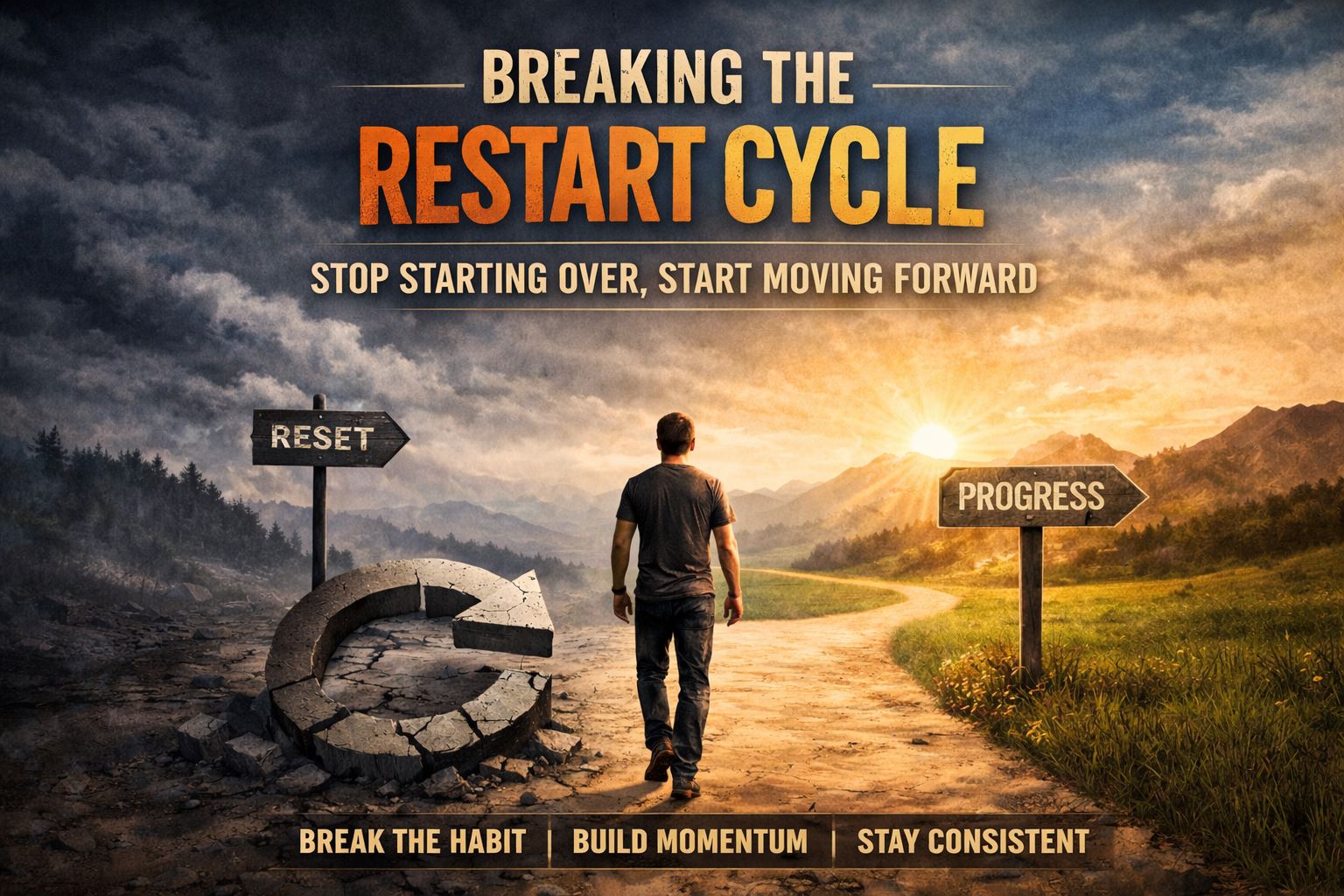
The restart cycle is the habit of treating every interruption like a full collapse.
You miss a workout, so you stop training altogether.
You miss two days of writing, so you abandon the whole writing plan.
You lose focus for one week, so you decide the entire routine has failed.
Instead of continuing imperfectly, you restart dramatically.
That is where progress begins to die.
Growth is rarely destroyed by one bad day. It is destroyed when one bad day turns into a new identity crisis. You stop seeing yourself as someone in process and start seeing yourself as someone who failed again.
That mental shift is costly.
Why Restarting Feels So Good
Restarting feels powerful because it gives emotional relief.
A fresh start removes the discomfort of facing your inconsistency. It lets you imagine a better version of yourself without doing the harder work of staying steady through imperfection. You get the excitement of a new beginning without the weight of long-term discipline.
That is why people love new weeks, new months, birthdays, and new years. These moments feel symbolic. They feel clean. They feel like permission to become someone else.
But progress is not built in symbolic moments.
It is built in ordinary days.
It is built when nothing feels special, when motivation is low, and when you still choose to continue instead of reset.
How the Restart Cycle Kills Your Progress
1. It Destroys Momentum
Momentum is one of the most valuable things you can build.
When you keep moving, even slowly, your habits begin to feel more natural. You spend less energy convincing yourself to act because action has already become part of your rhythm.
But every restart breaks that rhythm.
You do not just pause progress. You force yourself to rebuild momentum from zero. Again and again. That means every time you restart, you are making the journey heavier than it needs to be.
Many people are not exhausted because the goal is too hard. They are exhausted because they keep returning to the beginning.
2. It Weakens Self-Trust
Self-trust is built when you learn that you can rely on yourself.
Not perfectly. Not flawlessly. But consistently enough to believe your own word.
Every time you keep promising yourself a new beginning and then abandoning it, you chip away at that trust. You start doubting your own commitment. You start hearing your own goals as empty talk.
That damage is deeper than most people realize.
When self-trust is weak, even simple goals feel heavy. You hesitate. You overthink. You stop taking your own intentions seriously. Not because you do not care, but because your mind has seen too many unfinished attempts.
The restart cycle teaches you that your word to yourself has no weight.
That is dangerous.
3. It Keeps You Addicted to Intensity Instead of Discipline
People who live in the restart cycle often love intensity.
They want the big comeback. The powerful speech to themselves. The sudden transformation. The perfect routine. The all-or-nothing energy.
But lasting growth is rarely intense.
It is repetitive.
It is quiet.
It is often boring.
If you only respect progress when it feels dramatic, you will keep rejecting the kind of effort that actually changes your life. You will keep chasing emotional highs while avoiding stable systems.
That is why some people are always “about to change,” but never truly changing.
4. It Turns Mistakes Into Identity Statements
A disciplined person sees a mistake and says, “I slipped.”
A person trapped in the restart cycle sees a mistake and says, “This is who I am.”
That is the real problem.
You miss one step and then use it as proof that you are inconsistent, weak, unserious, or incapable. Instead of correcting the behavior, you question your identity. And once identity gets involved, the fall becomes much bigger than it needs to be.
One bad day should remain one bad day.
But in the restart cycle, one bad day becomes a story. And that story becomes an excuse to quit.
5. It Makes You Worship Perfect Timing
The restart cycle trains you to wait for ideal conditions.
You tell yourself you will begin again when life calms down, when the month starts, when your energy comes back, when the weather improves, when you feel ready, when you have the right plan, or when your mind is clear.
But progress does not belong to people who wait for perfect timing.
It belongs to people who move in imperfect conditions.
If you always need a clean emotional state to continue, then your life will always be controlled by your feelings. And feelings are too unstable to build anything meaningful on their own.
The Truth: Progress Needs Continuation, Not Constant Reinvention
Most of the time, you do not need a new plan.
You need to return to the old one without drama.
You do not need to redesign your entire life because you had a weak week. You need to continue. That is all. Continue with humility. Continue with honesty. Continue with less ego.
The mature version of growth is not always exciting. Sometimes it looks like doing the next right thing without making a speech about it.
That is how real change happens.
Not in dramatic restarts, but in quiet continuation.
How to Break the Restart Cycle
1. Stop Measuring Progress by Perfection
If your standard is perfection, you will always feel behind.
A better standard is this: Did I return quickly?
Because the goal is not to never fall off. The goal is to reduce how long you stay off. A strong person is not someone who never struggles. It is someone who does not stay down for too long.
The faster you return, the less damage the interruption causes.
2. Learn to Resume Instead of Restart
This shift changes everything.
Do not say, “I need to start again.”
Say, “I need to resume.”
That language matters. Restarting makes it feel like everything is lost. Resuming reminds you that you are still on the journey. You may have paused, but you are not back at zero.
That mindset protects momentum.
3. Build Smaller Standards
Many people restart because their routines are too heavy to carry consistently.
They create systems that only work on high-energy days. Then when life becomes normal again, the system collapses.
Build routines that survive ordinary life.
- Read two pages if you cannot read twenty.
- Work out for fifteen minutes if you cannot do an hour.
- Write one paragraph if you cannot write a full page.
Small consistency beats dramatic inconsistency every time.
4. Refuse Emotional Overreaction
Not every failure deserves a funeral.
Some days will be messy. Some weeks will be slower. That is part of life. You do not need to turn every interruption into a major personal disappointment.
Calm down. Adjust. Continue.
Your ability to stay emotionally steady after slipping is a huge part of long-term progress.
5. Focus on Identity Evidence
Every time you continue after imperfection, you collect evidence.
- Evidence that you are becoming someone reliable.
- Evidence that you do not need a perfect mood to act.
- Evidence that your growth is real, not just emotional.
That is how identity changes. Not through promises, but through repeated proof.
Final Thoughts
The restart cycle kills your progress quietly by stealing momentum, damaging self-trust, and making you dependent on emotional highs instead of steady discipline.
You do not need to keep becoming a new person every few weeks.
You need to stay with the process long enough for it to shape you.
So the next time you slip, do not disappear.
Do not create a new dramatic beginning.
Do not wait for Monday.
Just continue.
Because the life you want will not be built by how often you start.
It will be built by how often you refuse to start over.
Discover more from Mutembei William
Subscribe to get the latest posts sent to your email.